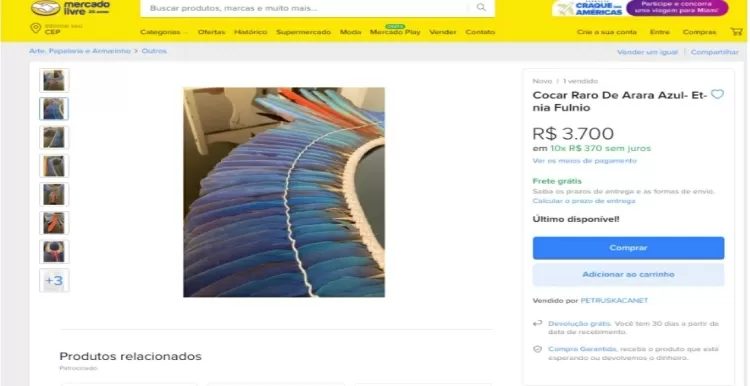
Indigenous objects produced with feathers from wild animals, whose purchase, sale and even possession are prohibited in Brazil, are sold freely on the internet. Finding these ads is not a challenge: simply search for "indigenous headdress" and "macaw feather" to reach social media like Facebook and Instagram and e-commerce sites like Mercado Livre and Enjoei.
Objetos indígenas, produzidos com penas de animais silvestres, cuja compra, venda e até guarda são proibidas no Brasil, são vendidos livremente na internet. Encontrar estes anúncios não é um desafio: basta buscar "cocar indígena" e "pena de arara" para chegar a redes sociais como Facebook e Instagram e sites de e-commerce como Mercado Livre e Enjoei.
Finding evidence of illegal trade
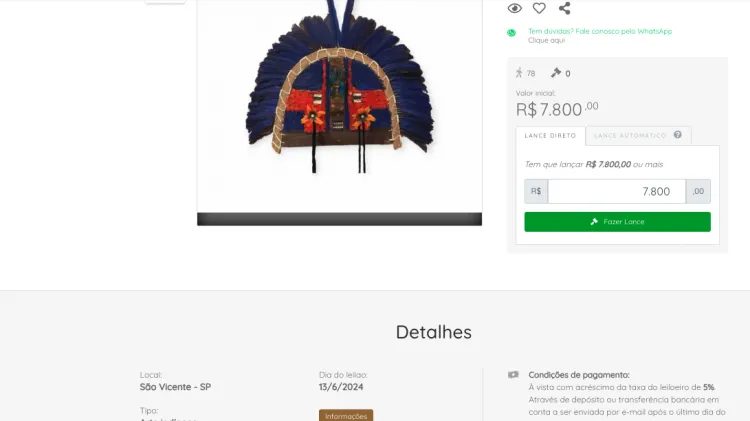
UOL identified that at least 21 of them sell or have sold indigenous headdresses with natural feathers. On Litoral Paulista Leilões, more than a hundred headdresses were auctioned with values between R$ 850 and R$ 7,800 each.
Via WhatsApp, an attendant from the auction company told the reporting team that the pieces are made with dyed feathers and not from wild animals, but refused to provide documentation of the origin of the auctioned material.
"That's company private information and it can't be released that way to just anyone who requests," the attendant said.
Encontrando evidências
O UOL identificou que pelo menos 21 deles vendem ou já venderam cocares indígenas com penas naturais. No Litoral Paulista Leilões, mais de cem cocares foram leiloados com valores entre R$ 850 e R$ 7.800 cada um.
Pelo WhatsApp, um atendente da empresa afirmou à reportagem que as peças são feitas com penas tingidas e não de animais silvestres, mas se recusou a fornecer documento de origem do material leiloado.
"São informações particulares da empresa e não pode sair assim dessa forma para qualquer pessoa que solicitar", disse.
"You have cocares of Brazilian ethnic groups commercialized for 80 thousand euros, bought here in Brazil for R$ 200, R$ 300."
Dener Giovanini, Renctas
"Você tem cocares de etnias brasileiras comercializados por 80 mil euros, comprados aqui no Brasil por R$ 200, R$ 300."
Dener Giovanini, Renctas
UOL showed the images of the pieces to professor and biologist Luís Fábio Silveira, curator of the bird section and vice-director of the Zoology Museum at USP (University of São Paulo). In one headdress he identified at least three species of macaws. "There is no evidence whatsoever of color or shape alteration of the feathers."
Litoral Paulista rebuffed the USP professor's statement, saying that "it's hardly possible for someone to confirm something from just a photo" and that it has been in the market for over 10 years.
O UOL mostrou as imagens das peças ao professor e biólogo Luís Fábio Silveira, curador da seção de aves e vice-diretor do Museu de Zoologia da USP (Universidade de São Paulo). Em um cocar ele identificou ao menos três espécies de araras. "Não há qualquer evidência de alteração da cor ou do formato das penas."
A Litoral Paulista rebateu a afirmação do professor da USP dizendo que "dificilmente alguém consegue constatar algo por apenas uma foto" e que está há mais de 10 anos no mercado.
A complaint that went nowhere
A dossier produced by Renctas (National Network to Combat Wildlife Trafficking), reporting more than a hundred cases with vendor names and advertisement links, was delivered to Ibama in June 2023.
"Until today we have not received any feedback," said Dener Giovanini, Renctas general coordinator.
Ibama denied access to the process to the reporting team in a request made through the Law of Access to Information, but admitted that no enforcement was carried out.
Denúncia ao ibama não deu em nada
Um dossiê produzido pela Renctas (Rede Nacional de Combate ao Tráfico de Animais Silvestres), denunciando mais de cem casos do tipo, com nomes de vendedores e links de anúncios, foi entregue ao Ibama em junho de 2023.
"Até hoje não recebemos nenhum retorno", disse o coordenador-geral da Renctas Dener Giovanini.
O Ibama negou acesso ao processo à reportagem em pedido feito por meio da Lei de Acesso à Informação, mas admitiu que nenhuma fiscalização foi feita.
What the platforms say
Mercado Livre reported that it removed ads cited by the reporting team after a notification made by Ibama. "We work tirelessly to combat the misuse of your platform, through the adoption of technology and teams that also conduct manual searches," the company said in a statement.
Enjoei said it was not approached by Ibama, but prohibits advertisements involving contraband of products with animal parts.
Meta, owner of Facebook and Instagram, stated in a statement that it prohibits content that promotes the purchase or sale of endangered animals and derived products. None of the links from the Renctas complaint, however, were removed, nor was a link to an Instagram page stating that the headdresses sold there are made with feathers from wild animals, including macaws, hawks and parrots.
O que dizem as plataformas de vendas
O Mercado Livre informou que removeu anúncios citados pela reportagem após uma notificação feita pelo Ibama. "Trabalhamos de forma incansável para combater o mau uso da sua plataforma, a partir da adoção de tecnologia e de equipes que também realizam buscas manuais", disse a empresa em nota.
A Enjoei disse que não foi procurada pelo Ibama, mas que proíbe anúncios que envolvam contrabando de produtos com parte de animais.
A Meta, dona do Facebook e Instagram, afirmou em nota que proíbe conteúdo que promova a compra ou venda de animais em risco de extinção e produtos derivados. Nenhum dos links da denúncia da Renctas, no entanto, foi removido, nem o de uma página de Instagram que diz que os cocares ali vendidos são feitos com penas de animais silvestres, incluindo araras, gaviões e papagaios.

Prohibited sale
The Brazilian Constitution and the Indian Statute allow indigenous people to use parts of wild animals in objects for cultural purposes, but the law states that no one, not even indigenous people themselves, can commercialize them.
Even when indigenous people practice commerce, they do not receive the largest share of profit, which in most cases goes to smugglers.
Two laws address the issue: the Wildlife Protection Law from 1967, which prohibits commerce in wild fauna specimens and products that involve their hunting, and the Environmental Crimes Law from 1998. However, enforcement of these laws is still in its infancy.
A survey sent to the reporting team by Ibama itself shows that, as of June, six infraction notices were registered in 2024; in the previous year there were 20. Almost all were against individuals, against indigenous people themselves or small artisans. Only one fine was against a company—a hotel in Espírito Santo. Fines ranged from R$ 500 to R$ 85,000.
Venda proibida
A Constituição brasileira e o Estatuto do Índio permitem que indígenas usem partes de animais silvestres em objetos para fins culturais, mas a legislação diz que ninguém, nem os próprios indígenas, pode comercializá-los.
Mesmo quando os indígenas praticam o comércio, não são eles a receber a maior fatia do lucro, que na maioria das vezes fica na mão de contrabandistas.
Duas leis tratam do tema: a de Proteção à Fauna, de 1967, que proíbe o comércio de espécimes da fauna silvestre e de produtos que impliquem na sua caça, e a de Crimes Ambientais, de 1998. A fiscalização dessas redes, no entanto, ainda engatinha.
Um levantamento enviado à reportagem pelo próprio Ibama mostra que, até junho, seis autos de infração foram registrados em 2024; no ano passado houve 20. Quase todos são contra pessoas físicas, contra os próprios indígenas ou pequenos artesãos. Só uma multa foi contra uma empresa — um hotel do Espírito Santo. Os valores das multas variam de R$ 500 a R$ 85 mil.
"The activity continues to exist, in a more technological manner and with fewer intermediaries."
Cristiano Nascimento dos Santos, Federal Police
"A atividade continua a existir, de maneira mais tecnológica e com menos intermediários."
Cristiano Nascimento dos Santos, Polícia Federal
6
Infraction notices in 2024 (through June)
21+
Platforms selling headdresses
6
Autos de infração em 2024 (até junho)
21+
Plataformas vendendo cocares
'village headdress'
The pieces are also sold abroad. The reporting team found advertisements for "kayapó headdress" made with wild animal feathers on the Etsy and 1stDibs websites. One of the pieces cost more than R$ 250,000.
1stDibs stated in a note sent to the reporting team that it "does not believe that the pieces violate Brazilian laws due to the documentation provided by the seller." The company refused to provide a copy of such documentation, citing customer privacy.
After contact, the advertisement was updated and included information that the feathers would have been obtained in France legally, although it maintains in the title that the headdress is in the kayapó style, a Brazilian ethnic group. Etsy did not respond to the email sent.
'cocar de aldeia'
As peças são vendidas também no exterior. A reportagem encontrou anúncios de "kayapó headdress" (cocar kayapó) feito com penas de animais silvestres nos sites Etsy e 1stDibs. Uma das peças custava mais de R$ 250 mil.
A 1stDibs disse, em nota enviada à reportagem, que "não acredita que as peças violem as leis brasileiras devido à documentação providenciada pelo vendedor". A empresa se recusou a fornecer cópia de tal documentação, alegando privacidade do cliente.
Após o contato, o anúncio foi atualizado e incluiu a informação de que as penas teriam sido obtidas na França, de maneira legal, embora mantenha no título que o cocar é no estilo kayapó, um grupo étnico brasileiro. A Etsy não respondeu ao e-mail enviado.
How the state created demand
Enforcing the law in Brazil is a challenge, since the state itself stimulated this market. Funai, created in 1967, sold indigenous artifacts in stores in several cities across the country until 2004.
A study conducted by the foundation in 2006 admitted that the agency may have been partially responsible for making indigenous featherwork an object of speculation in the international market.
Some of the advertisements found in auctions and websites state that the origin of the pieces is Funai itself. Another challenge is concern about harming indigenous populations, who depend on handicraft commerce for their own subsistence.
The sale of pieces with wild animal feathers by Funai only formally ended when the Federal Police launched Operation Pindorama in 2021, which seized objects and arrested agency employees in Brasília. The investigations showed that a North American was ordering animal parts via fax, including individual feathers, with support from agency staff. The Federal Police delegate who conducted the case, Jorge Pontes, said that the handicraft was a "mere facade for wildlife trafficking and animal slaughter."
Funai ajudou a criar demanda
Fazer a lei "pegar" no Brasil é um desafio, já que o próprio Estado estimulou esse mercado. A Funai, criada em 1967, vendeu artefatos indígenas em lojas em várias cidades do país até 2004.
Um estudo feito pela fundação ainda em 2006 admitiu que o órgão pode ter sido parcialmente responsável por fazer a plumaria indígena virar objeto de especulação do mercado internacional.
Parte dos anúncios encontrados nos leilões e sites diz que a origem das peças é a própria Funai. Outro desafio é o receio de prejudicar populações indígenas, que dependem do comércio de artesanato para o próprio sustento.
A venda de peças com penas de animais silvestres pela Funai só acabou formalmente quando a Polícia Federal deflagrou a Operação Pindorama, em 2021, que apreendeu objetos e prendeu funcionários do órgão em Brasília. As investigações mostraram que um norte-americano encomendava partes de animais via fax, inclusive de forma avulsa, com apoio de servidores do órgão. O delegado da Polícia Federal que conduziu o caso, Jorge Pontes, disse que o artesanato era "mera fachada para o tráfico e a matança de animais".
"They [Ibama] should be monitoring non-indigenous people instead."
Indigenous artisan, Alagoas
"Eles [Ibama] teriam que fiscalizar era os não indígenas."
Artesão indígena, Alagoas
The reporting team spoke with three indigenous traders from communities located in Alagoas and Bahia, who say they depend on sales. "It's just another way for them to want to erase us. On top of everything they've already taken from us," said one of them, considering the prohibition on commerce a lack of respect. Another indigenous trader revealed that the most common customers are architects and people who work with interior design.
A reportagem conversou com três comerciantes indígenas, de comunidades localizadas em Alagoas e na Bahia, que dizem depender das vendas. "É mais uma forma de eles [governo] quererem nos descaracterizar. Já não basta o tanto que tiraram de nós", disse um deles. Outro indígena ouvido afirmou que os clientes mais comuns são arquitetos e pessoas que trabalham com decoração.